
Privacy and Private Transactions

Photo Credit: Nikolas Noonan, from Unsplash.com.
The $7.5 million dollars in a storage unit
In 2018, a man bought a storage unit, which had not been claimed for more than 3 months. To his surprise, the storage unit contained a safe with $7.5 million in cash. The man was soon contacted by the former owners of the container, and offered $1.2 million for returning his find to the former owners. For $500, the amount he spent on the storage unit, he had become an overnight millionaire.
Naturally, you as the reader would wonder why $7.5 million was stashed away in a storage unit. Were the funds illicit? And if they were legitimate, why didn't the owner of the funds put them into a bank, where their deposit would be safe and insured?
But there are a number of legitimate reasons that the funds could have been kept in a storage unit: Perhaps the funds were being held in escrow, to be paid in cash for a legitimate transaction; or the owners could have an unnatural aversion to the banking system, and decided to operate their own piggy bank. It could also be that the funds were illicit, and that they were placed in the storage unit because they were tainted, and would have been seized.
In any case, the lucky man had, arguably, only been sold a storage unit, and not the cash within. Its previous owners had a right to reclaim what was theirs, which they had never given up their right to. Insisting otherwise would attract a claim of unjust enrichment, and the tort of conversion, or criminal misappropriation, when the actual owner became known to the lucky buyer.
OFAC's sanctions on Tornado Cash
This issue of the legitimate uses of a storage unit to store large amounts of cash, has relevance to crypto and blockchain technologies. Recently, the OFAC (Office of Foreign Assets Control), a department within the US Treasury, has decided to sanction Tornado Cash.
Tornado Cash enables individuals to move cryptocurrency from one address to one or more addresses, while obfuscating the traceability of the transactions. In other words, if you want to move crypto from wallet A to wallet B, but don't want people to trace the movement of your money, you can use Tornado Cash.
Tornado Cash is an example of a tumbler, or a mixer. A simple way to think of it, is as a massive liquidity pool where anyone can deposit liquidity, and liquidity can be withdrawn only by persons possessing a secret "note".
For obvious reasons, regulators and enforcement agencies loathe mixers and tumblers like Tornado Cash, because it stops them from tracking the flow of funds. When Kassim deposits crypto into Tornado Cash, that's often where the trail ends. Somebody else, or Kassim, could come back to Tornado Cash, a week or a month or even a year later and withdraw that cash, in full or in chunks. Because the withdrawals can be carried out over multiple transactions, it becomes difficult to match the input and output figures.
Mixers and tumblers do have legitimate uses. For example, a person with a large holding of crypto may wish to move his funds to another wallet without being monitored. He may be a celebrity or a famous person, and wishes to preserve his privacy. It is not an offence to want to preserve his privacy. Another example, which is arguably still legitimate, but skirts with sanctions laws, is donation for humanitarian purposes, to recipients in sanctioned countries, such as Yemen.
Incidentally, a Twitter user highlighted that making donations to help Ukraine using Tornado Cash, to avoid Russian surveillance, is a legitimate use of the service. To which Vitalik Buterin, the founder of Ethereum replied, "I'll out myself as someone who has used TC to donate to this exact cause."
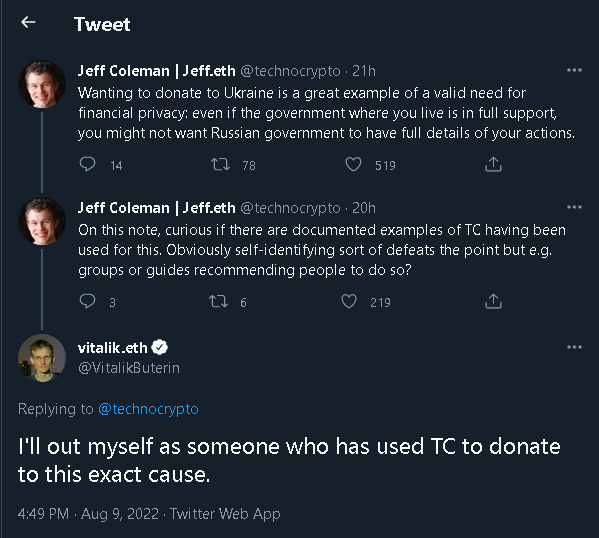
Source: Twitter
It's not all about money laundering, even though an unintended consequence of opening up the service to the world is that, bad actors can and will use the service. As a privacy preserving tool, mixers and tumblers generally do not require KYC from their users. However, it also means that bad actors, acting anonymously, may make use of the system for their own nefarious purposes.
In the end, its how the tool is used, and who uses it, that determines whether it is harmful to society. If we consider that kitchen knives are regularly featured in news items as the murder weapon, evidenced by multiple stab wounds in the victim, then would it not be reasonable, by the same logic, to declare that kitchen knives should also be sanctioned, and sold only to people who have submitted their KYC?
To be clear, this is not the first salvo that has been fired by the regulators, nor will it be the last. FATF has issued warnings that privacy coins and anonymity enhancing coins (AEC) are red flags for money laundering. Under FATF guidance, VASPs (virtual asset service providers) need to comply with the travel rule i.e. identify where money comes from. And earlier in the year, Blender io, another mixer, was sanctioned by US regulators for abetting money laundering.
All this makes tumblers and mixers look like the locker rooms in movies, where the bad guy tells the good guy, "I have your son, put $100,000 in a duffel bag and place it in locker #21." As this piece points out, there are legitimate uses of tumblers and mixers, and if a person decides to put in his money into a duffel bag, and place it in a locker, only to retrieve it himself, say, half a year later, would it make him a criminal? If, let's say, his girlfriend picks up the duffel bag, because she's his baby momma, and because his wife doesn't need to know about it, does it make her (the girlfriend, not the wife) a criminal?
Privacy is a right, but KYC/AML is an important part of the mass adoption of crypto. Until that happens, these questions will continue to play out. These are defining times, and the public debate will help shape the law to come.
This article was originally published at the author's Linkedin.
