The Art of Derugging NFT Communities, with Sacred Labs
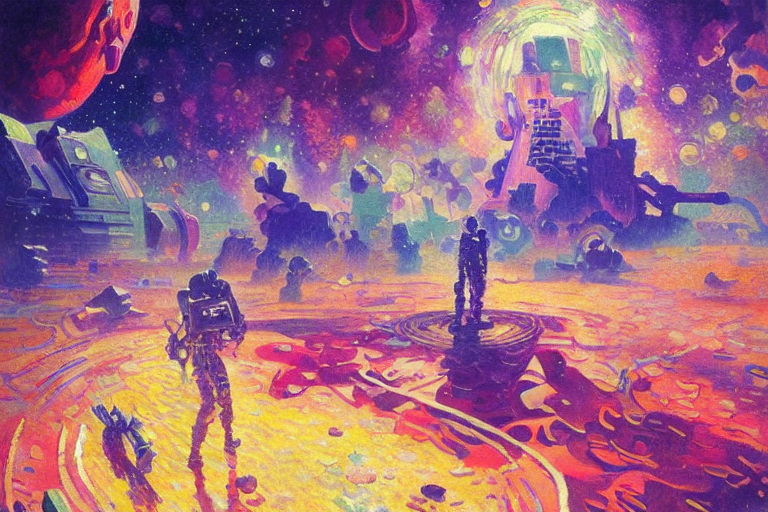
Image created by Kevin Koo with AI software
The art of the derug
Recently we collaborated with ChrisB, an NFT artist and a photographer, to interview Cookie, the founder of Sacred Labs, and Farts of Poseidon, a team member of both Sacred Labs and Solana Pixel Bots. Even though it is currently only 9-10 weeks old, Sacred Labs has been doing a great job in derugging / unrugging 13 NFT communities, and they are adding to that number week by week. Here is a brief recap of the interview (which you can listen to here) and what we learned. Suffice to say that it was a great interview! The only let down was my microphone, for some reason it was soft. It runs for an hour, so it's not that long.
So what is a rug or a rugpull?
An NFT rug or a rugpull happens when the founders disappear from the scene, with the funds of their collectors. It happens fairly frequently in the NFT scene, due to founders having an anonymous persona. Naturally, this causes a lot of pain for the collectors as they realise that the project's milestones will not be delivered. Thus, in a rug or rugpull, the promised utility of the NFT project becomes negated, and non-existent. Even seeking a refund becomes impossible. The only way out is to sell the rugged NFTs for a fraction of their original price... or is it?
Well, not really. You can try to rescue the community by derugging it. And that's where we get into ...
What is derugging? And how do you derug an NFT community?
In a derugging / unrugging effort, the main idea is to give hope and real value to the community. In most cases, everybody hopes that somebody will do something, but not many people dare to step up to the job. And for that reason, many people will just walk away from a rugpull.
Successful derugging efforts often take one or more of the following forms:
- Getting the rugged community to burn their rugpulled NFT to receive a new derug NFT;
- Airdropping a number of the rugged community a new derug NFT;
- Giving whitelists or even special minting price for members of a rugged NFT community;
- Any other utility which could help console the rugged community's members.
Derugging an NFT community requires a concerted effort from the community to push for a certain derugging effort, to migrate the community to a new one, while building new utility, generating profits from a new mint, and using it to continuously add value to the NFT community.
Derugging an NFT community is like M&A, in Web2 where companies acquire ailing and failing companies and turn them around.
The Sacred Labs story
Cookie is an ex-military officer, but now works as a chef. Not long ago, Cookie, the founder of Sacred Labs, experienced a rug pull. Unlike most rug pull victims, he decided that he wanted to do something about it, and found an ally in Bursteways, another community member. He spoke with the developer and found that the founders were not releasing funds, and therefore the developer was reluctant to do the work. Ironically, it was this same situation that was being used as an excuse by the
Cookie decided that he would begin the derugging effort, and his first de-rugging effort involved launching a token called the Sacred Coin. With that, he built the Sacred Labs ecosystem, making new games such as dice games, blackjack, and raffles, which made use of the Sacred Points. From there, one project after another found out about the Sacred Labs project and brought their communities to them, to be derugged.
The first idea promoted by the Sacred Labs team was a raffle system with perpetual compounding. Anyone could buy into the tokens to participate in a raffle. Over time, the pool of tokens keeps getting bigger and bigger, as more and more people buy tickets. Also, the team have added their own in house games for their community members. To play, members would need to have Sacred Points, which can be earned by staking NFTs and other tokens related to the project.
The Sacred Labs team began building a development arm. Their first project was for the Los Cactus community. Sacred Labs built a burn and mint facility where they could burn their rugged NFT and receive an airdrop for a new token.
At the moment, 13 projects have been unrugged, There are 3 more in the pipeline, and 3 more from Solana Pixel Bots. The current total of projects is 19.
At this time, Cookie has honed his process of talking to a founder to about 35 minutes. A message is often posted in the Discord server of the rugged NFT community. The intention to take over the project is often made clear. The rugged project community would be invited to join Sacred Labs' Discord server.
Cookie claims to be an ex-military officer, having served as a chef. He now owns his own business where he works as a chef.
His dream is to eventually build a marketplace for project founders to buy and sell rug projects. Derugging is not intended to challenge decentralization but it is an effort to keep a community going. He also wants to keep the raffles going. He hopes to grow the project and recruit more clients for development work. To do that, he intends to implement innovative ideas, and even white label the solution for other projects.
Under Cookie's watch, Sacred Labs would usually sweep up a project which was going to be taken over, and airdrop it to their own Sacred Labs community members.
Dylan will usually scout projects that would like to be derugged by the Sacred Labs crew, and figure out what kind of utility can be delivered by the Sacred Labs crew.
Common Issues in Rugged Communities
When communities realise that the founders are going to rug, they tend to give up. Founders often put the blame on the development costs, but the reality is often that the founders refuse to release funds to the developers.
Developers have the keys to the kingdom, but they need to be paid. And when they are not paid, they do not want to work. If the founders paid the developers, the developers would be working.
For Sacred Labs, the front end and back end developers are co-owners of the project. Thus, the developers have a stake in the project and the project can move quite quickly.
The most important aspect is making sure that the community gets something back so that they aren't totally out of pocket.
There are circumstances where the team is unable to help. If the project is dead and buried then it is difficult to revive it.
Many people do not know that you can take over a project and continue to run it, if the developers agree.
Sacred Lab's Advice to Rugged Communities
The community members need to stay calm and cooperate with the de-rugging team. It is important to find out about the circumstances of the rug. What kind of rug was it? Slow rug or sudden rug? Why rug?
Then, a more important part would be to discuss with the founders and the developers, what they want to hand over control of the project (together with the private keys) to the new team. It could be a share of the royalties, paid to their wallets; a share of the mint proceeds; perhaps some NFTs; and in other cases, tokens. In Cookie's own words, the key is to find out how the founders want to be able to walk away with their heads held high.
Once the founders have agreed with the team, Sacred Labs would speak with the community members and try to give them access to the Sacred Labs ecosystem through the Sacred Points, which would be given to the rugged community members. The Sacred Points can be staked to earn Sacred Points. Sacred Points can be used to play games.
The Sacred Labs team would usually invite the community members to come join the Sacred Labs server. Usually about 100 to 150 of the original rugged community would join the Sacred Labs server, where they add value to the Sacred Labs ecosystem, but also benefit from the ecosystem.
The role of Solana Pixel Bots
The Sacred Labs people met Solana Pixel Bots team in a space and decided to work together. Cookie, the Sacred Labs founder, remembers Farts of Poseidon asking him, whether he wanted to compete, or collaborate. The rest, as they say, is history. Solana Pixel Bots and Sacred Labs have since formed a working relationship which is still on-going, and the latest output is the Sacred Guardians, which are used for the de-rugging service.
Dylan is the owner of Solana Pixel Bots and the lead for the Sacred Guardians. (The NFT for the derugging service.)
The Sacred Labs ecosystem
Within the Sacred Labs ecosystem, there are many components, and there are likely to be many more to come. Today, Sacred Labs has de-rugged 13 communities, and each community being added to the Sacred Labs ecosystem means that the ecosystem needs to grow. Here are some of the features of the Sacred Labs ecosystem:
- Staking is a way to use Sacred Points tokens to earn Sacred Points. But as per our understanding, the staking platform could also be used to stake other NFTs, even the ones from the rugged project, so that each rug community's member may receive the Sacred Points, which can be cashed out and used for other purposes.
- Raffles are a part of the Sacred Labs experience, and each raffle uses Sacred Points.
There is no burning mechanism for supply control.
3. Burning platform. Communities can burn their NFTs to receive an airdrop. A good example is the portal for holders of Los Cactus Hermanos NFT which allowed rugged NFT holders to burn their rugged NFT, and receive an airdrop from the new portal owner. But, the burning platform can also be used for the Sacred Labs community members. Once example is the Sacred Labs NFT, of which 10 of them can be burned to receive a Sacred Guardian.
Cookie tries to make the ecosystem work by giving away NFTs, Solana and DUST from his own collection. He also runs his own Discord and hangs out in the Discord voice chat where people can find him. He knows that his presence is essential to make the project work.
The blind auctions for wallets full of NFTs
Storage Wars is a brainchild of Cookie, where people bid on a wallet full of NFTs without knowing the actual contents of the wallet. Recently, a wallet with NFTs worth 11 SOL was auctioned off; for a bid of 7.5 SOL.
The winner of the wallet blind auction will have a seed phrase given to him, for the winner to see what is in the wallet and to deal with it. It is advisable to move the NFTs out of the wallet than to leave them in the wallet. Each round of Storage Wars would require the team to set up a new wallet so that they could give the wallet to the bid participants.
Dealing with IP in a rugged project
The Sacred Labs project's artist Benny works to create artwork for the unrugged projects. Sometimes they work with the original artist (of a rugged community) to create new artwork, which can then be minted for a new collection. In this way, the continuity of the same artist may give a sense of renewal and consistency to the community members.
When the project owner hands over the IP of the artwork and the writings to the de-rugging team, the IP issues are cleared.
Getting in touch with the Sacred Labs crew
If you want to get in touch with the Sacred Labs crew, here are some helpful links:
- Website: https://sacredlabs.io
- Discord: discord.gg/sacredlabs
- Twitter: https://mobile.twitter.com/SacredLabs
Thank you for reading
We hope this article has proved useful to help you understand the process of de-rugging from the perspective of a successful de-rugger. Meanwhile, please join our social channel to interact with our founder.